
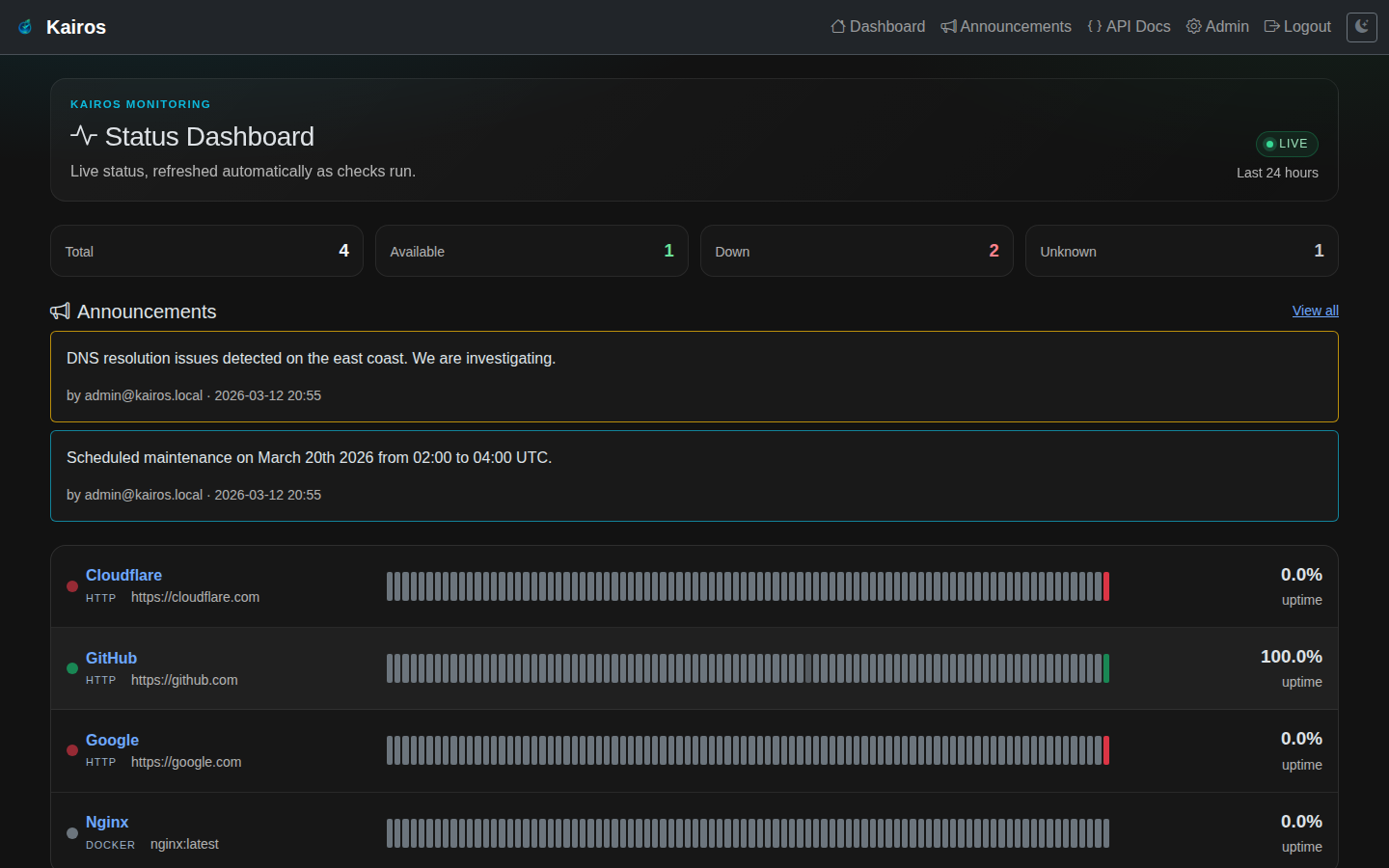
After some weeks of development, I’m excited to announce the first public release of Kairos — a fully self-hosted, open-source availability and uptime monitoring solution for developers and platform teams who want full control over their infrastructure observability.
Why Kairos?
Most uptime monitoring tools force you to choose between a cloud SaaS product with per-check fees, limited retention, and data leaving your network — or a heavy, complex setup that takes hours to configure. Kairos was built to close that gap: a batteries-included solution that runs on your own infrastructure, costs nothing beyond your server, and is up and running in minutes.
What Kairos Can Do
- HTTP Monitoring — Configurable periodic GET checks with parallelism control; checks start instantly on startup, no waiting for the first interval tick
- Docker Image Probing — Validate whether container images are pullable via the OCI/Docker Registry API — no Docker socket required
- Repository Discovery — Point Kairos at a registry prefix and it auto-discovers all hosted images, with optional recursive traversal
- Status Dashboard — Public-facing dashboard with 24-hour timelines and uptime percentages (24h / 7d / 30d)
- Announcement System — Publish rich-text announcements with INFORMATION, WARNING, or PROBLEM severity, including optional auto-expiry
- Prometheus Metrics — Native
kairos_resource_statusgauge exposed at/actuator/prometheus, ready to plug straight into Grafana - Resource Groups — Organise monitored services into named groups with drag-and-drop reordering
- API Keys & OIDC — Machine-to-machine access via named API keys, plus full OpenID Connect login (works perfectly with Keycloak)
- H2 or PostgreSQL — Start immediately with embedded H2 or switch to PostgreSQL with a single property; Flyway handles all schema migrations automatically
Getting Started
Kairos is designed for minimal time-to-value. Pick your preferred deployment method:
Docker
docker run -d \
  --name kairos \
  -p 8080:8080 \
  -v kairos-data:/app/data \
  ghcr.io/wenisch-tech/kairos:latest
Helm on Kubernetes:
helm repo add kairos https://charts.wenisch.tech
helm repo update
helm install kairos kairos/kairos --version 1.0.4 \
  -n kairos --create-namespace \
  --set persistence.enabled=true
Once running, navigate to http://localhost:8080, log in with the default credentials (admin@kairos.local / admin), and change your password immediately. Then add your first HTTP service or Docker image — Kairos begins checking right away.
Built for Real Infrastructure
Kairos ships with a full REST API at /api with an auto-generated interactive Swagger UI. There are no artificial limits on the number of monitored resources, no CDN dependencies, and no check history retention caps. Deploy it, wire up Prometheus, and let it run.
Open Source & Free
Kairos is released under the GNU GPLv3 licence. The source code is on GitHub at github.com/wenisch-tech/kairos and the project homepage with full documentation is at kairos.wenisch.tech. If you give it a try, feedback and contributions are very welcome — open an issue, submit a PR, or drop a ⭐ if Kairos saves you from another SaaS subscription.